November 12, 2013

Protecting the unborn from pain

Inline image 1

Editor's note. This op-ed appeared in Thursday's Washington Times.

Carol Tobias, President of National Right to Life, speaking at Thursday's press conference where pro-life Senator Lindsey Graham (left) introduced in the Senate the Pain-Capable Unborn Child Protection Act, the law National Right to Life has helped pass in 10 states.  Photo by Chip Somodevilla/Getty Images.

In June, the U.S. House of Representatives voted 228-196 in favor of the Pain-Capable Unborn Child Protection Act. On Thursday, Sen. Lindsey Graham, South Carolina Republican, announced that he would introduce the bill in the U.S. Senate. Appearing on "Fox News Sunday" last weekend, Mr. Graham noted that protecting pain-capable unborn children from the horror of abortion "is a debate worthy of a great democracy."

There is substantial medical evidence that unborn children are capable of experiencing pain by at least 20 weeks post-fertilization. Abortions performed at this stage of pregnancy use a variety of techniques, including a method in which the unborn child's arms and legs are twisted off by brute manual force, using a long stainless steel clamping tool.

While most of us can hardly imagine undergoing a dental procedure without the benefit of anesthesia, the law of the land under Roe v. Wade condones this violent dismemberment of unborn children without any regard for their rights or humanity. Common decency demands that this be changed and that these unborn babies be protected.

Based on a 2008 study from the Guttmacher Institute (which was originally founded as a special research affiliate of the Planned Parenthood Federation of America, currently the nation's largest abortion provider), we estimate there are at least 140 abortionists in the United States who perform abortions on unborn children who are at least 20 weeks of fetal age.

When the Supreme Court handed down Roe v. Wade in 1973, our understanding of pain and the development of the unborn child was so primitive that even a newborn undergoing surgery did not receive anesthesia — only a paralytic to keep them still.

Medical advancements have changed the way we view unborn children. Today, unborn children undergo surgery in utero. Ultrasound technology has allowed a baby's first pictures to adorn the refrigerators of parents and grandparents long before they meet their newest family member face-to-face. Yet under current law, the same arms and legs seen in ultrasound images can be brutally torn apart during an abortion.

Just how many late abortions are performed in the United States on pain-capable unborn children? While we don't have a good handle on just how many late abortions are really occurring, there is growing evidence that they are far more common than most people want to think.

The case of Pennsylvania abortionist Kermit Gosnell and hidden-camera videos issued by the organization Live Action provide further evidence that a great deal of the late-abortion iceberg is below the water. Some of the jurisdictions with the most liberal abortion policies have no reporting requirements — for example, California, Maryland and the District of Columbia — or do not collect data on the stage of pregnancy (Florida, for example).

Other jurisdictions have reporting requirements, but don't enforce them. The grand jury report on Gosnell said that between 2000 and 2010, he reported only one second-trimester abortion to the state. Yet it appears that Gosnell probably performed thousands of second-trimester and third-trimester abortions during that decade. Multiple other practitioners who perform large volumes of late abortions have also failed to report them or have not been required to report them.

Enough is enough. It's time to revisit Roe v. Wade's policy of allowing unrestricted abortion.

Ten states have already enacted laws protecting pain-capable unborn children based on National Right to Life's model bill. Just last week, language protecting pain-capable unborn children went into effect in Texas. The pain-capable unborn child language was written into a larger omnibus pro-life bill that brought on a pro-abortion media frenzy during Texas state Sen. Wendy Davis' filibuster in June. Late last Friday, the 5th U.S. Circuit Court of Appeals cleared the way for the challenged provisions of the Texas law to take effect. The language protecting pain-capable unborn children went unchallenged by pro-abortion activists.

A nationwide poll conducted in March 2013 by The Polling Company found that an overwhelming majority of Americans — 64 percent — would support a law such as the Pain-Capable Unborn Child Protection Act; only 30 percent opposed such legislation. Female voters split 63 percent to 31 percent in support of such a law, and among independents, it enjoyed 63 percent support as well.

Speaking on "Fox News Sunday," Mr. Graham said, "The government has a legitimate interest to protect the child after the 20-week period of development because they can feel pain. That is what a rational, humane society should do — protect the child that can feel pain from an abortion."

One-fifth of the states, nearly two-thirds of Americans and the U.S. House of Representatives agree. Now it's time for the U.S. Senate to do its job and act to protect these vulnerable members of our human family.

Contact: Carol Tobias, President, National Right to Life

November 8, 2013

Adoption: the option everyone can live with

Editor's note. Melissa is the survivor of a "failed" saline abortion in 1977. She speaks all over the world including at the last three National Right to Life Conventions.

Inline image 1
Melissa Ohden (right) and Lisa Andrusko, NRLC 
Yearbook Editor, at the 2013 National Right to Life 
Convention

November is Adoption Awareness Month. Adoption is the option that everyone can live with–the mother, the father, the extended families, and, literally, the child.

Over fifty-five million lives ended through abortion in our nation have left countless women, men, and their families wounded. Adoption, by contrast, brings a legacy of life and love into this world. Both create a ripple effect for generations to come, one for ill, one for good.

Yet we live in a world today that often talks about adoption in disparaging

terms: Adoption is a burden on women. No right person would ever "give up" their child.

I've had women state that because they could never 'give up' their baby, they would abort them, instead.

I've even been told that it's adoptees like me, who search for our biological

families that make adoption an unappealing option in the face of an unplanned pregnancy. I am certainly not buying that or any of the other

misconceptions about adoption in our world.

What I am going to do, though, is continue to fight for abortion to be abolished and adoption to be looked at as the positive choice that it is. I will do my best to encourage people to have conversations that encourage others to do likewise.

Take advantage of Adoption Awareness Month this November, and have the conversation, in person with people or via social media and the Internet.

Together we can change the lens through which adoption is looked at and talked about in our world.

Contact: Melissa Ohden, National Right to Life

Pro-lifers in Iowa applaud Board of Medicine for banning webcam abortions

Inline image 1

An Iowa judge has called for a full trial before deciding whether to end webcam abortions in the state, which is where the procedure originated. 

The Iowa Board of Medicine made the decision to ban webcam or telemed abortions effective this week prompting Planned Parenthood to file a lawsuit.

Jenifer Bowen, who heads Iowa Right to Life, says the Judge Karen Romando placed a temporary injunction on the Board of Medicine's decision, which was made in August.

Romano is also likely to preside at the trial.

After the decision, Bowen checked social media and chatted with ardent pro-aborts who were lauding the decision and pushed back against Bowen's warnings.

Bowen
"You know, when I mentioned that there were at least 14 women who have died from complications of chemical abortions, I was accused of using those women as props," Bowen tells OneNewsNow.

Bowen also noted on social media that more than 2,200 women have been injured or have severely hemorrhaged, and again she was  accused of using women as "props."

The Iowa Right to Life spokesman suggests that shows a lack of concern, since there are grieving families because of the deaths and serious injuries, and babies that were killed because of chemical abortions.

Bowen says abortion chemicals are dangerous, and she is looking forward to the trial date. 

Contact: Charlie Butts, OneNewsNow.com

Texas pro-life law goes before Supreme Court justice

Inline image 1

Texas Planned Parenthood has gone to the U.S. Supreme Court, according to one expert, in a desperate move to avoid complying with a new state law. 

The new law, which requires abortionists to have admitting privileges in a local hospital and to follow federal guidelines in using RU486, has gone into effect after the 5th U.S. Circuit Court of Appeals refused to halt the law.

The American Civil Liberties Union has filed an emergency appeal with the U.S. Supreme Court, though the current law is currently in effect and enforceable.

Saenz, Jonathan (Texas Values)Jonathan Saenz of Texas Values says Planned Parenthood clinics are closing because they "refuse to follow state laws" that were approved by a majority of the Texas legislature.

"So Planned Parenthood is choosing themselves to close their clinics because they don't want to follow the law," he adds.

The Texas Planned Parenthood appeal is being decided by Justice Antonin Scalia, who handles emergency appeals from Texas. He is also pro-life.

"Justice Scalia has asked the state to respond by next week so we know there's not going to be a decision before then," says Saenz, "but I seriously doubt that we're going to see anything happen."

He says it's "quite extraordinary" for the U.S. Supreme Court to take a decision like this.

"And if Scalia is the one that's driving this issue," he adds, "that makes it even more unlikely to do anything to help Planned Parenthood."

The state faces a deadline of next Tuesday to respond. 

Contact: Charlie Butts , OneNewsNow.com

Science benefits from ethical standards

Inline image 1

Stable human embryonic stem cell lines, or hESCs, were first reported and described for scientific research in 1998. To some, these cells promised an ideal source of testing material for new drugs and therapies because they could be grown in the lab indefinitely without losing their characteristics and turn into any cell in the body. 

However, the ethical roadblocks for using hESCs -- destroying human embryos is required to isolate the cells -- cannot be overlooked.

Though embryonic stem cells have vocal supporters in the scientific community, most researchers take the ethical problem seriously, and the majority of medical research has advanced without their use. Adult stem cells -- regenerative cells taken from consenting adults -- are used in the vast majority of clinical trials, with only 2 of the 1,750 ongoing trials in December 2012 using embryonic cells.

Despite the success in using adult stem cells, there are limits to their functionality. For example, they do not incorporate themselves into any repaired tissue or create new tissue on their own. Adult stem cells mainly affect an injury or defect by releasing helpful proteins and controlling inflammatory responses but ultimately die or are removed by the immune system within a few weeks.

The journal "Human Molecular Genetics" recently published a review of the advances made using a new type of stem cell called induced pluripotent stem cells, or iPSCs. The author of the paper believes that over the last seven years this new type of cell has transformed not just regenerative medicine but biology as a whole. 

Discovered in 2006, iPSCs are just as versatile as embryonic cells, and they are able to create any cell type in the body. This new class of stem cells was created by taking skin cells from an adult and treating them with molecules called transcription factors that alter which genes are active within a cell. 

Researchers were able to use these transcription factors to induce the adult cells into an embryonic state, meaning they behave similarly to cells derived from embryos. Not only has this discovery replaced the perceived need for embryonic stem cells, their origin also has opened up several new opportunities for research and medical practice.

Induced pluripotent stem cells taken from patients with genetic diseases can reproduce important features of that disease in the lab setting. This allows researchers to develop disease modeling techniques that can observe disease progression and effectiveness of new drugs, not just in approximate models, but with real human genetic disorders. 

Neural cell types are easily created from iPSCs, and a functional model of Huntington's disease is already in use. Therapy with iPSCs also opens up the possibility of using a patient's own cells as part of a treatment that replaces tissue destroyed by disease and injury, reducing the chance of the immune system killing therapeutic cells derived from another source.

New possibilities for reducing age-related disorders also are on the horizon due to the research involving iPSCs. Skin cells from a 100-year-old person have been induced back to a stem cell-like state and behave like cells acquired from young individuals. 

Evidently, we can rejuvenate our cells and renew stem cell activity no matter our age. Macular degeneration and retinitis pigmentosa are two age-related disorders that, at least in the lab, can be repaired with iPSC therapies.

Induced pluripotent stem cells have not solved all of the challenges found with embryonic stem cells. There are still the shared problems with tumor formation in some applications and immature development of many cell types. However, these are challenges to current scientific protocols, not ethical challenges. 

Predictions of when new therapies will be available are difficult to make, but the possibilities already include disease modeling, simple organ generation and cellular rejuvenation.

These developments should be encouraging to those who have stood against the destruction of human embryos and the use of human embryonic stem cells even when no alternative had yet been found. 

The discovery of induced pluripotent stem cells shows that science does benefit from being held to ethical standards. 

The ethical roadblocks to using embryonic stem cells guided scientific research into a new direction, meeting the functionality of embryonic stem cells with an ethical alternative and, at the same time, opened up new areas of application.

Contact: Joshua Bush, Baptist Press

Joshua Bush, son of the late seminary professor L. Russ Bush, has a Ph.D. in chemical engineering. He is a deacon at First Baptist Church Park Street in Charlottesville, Va.

“Americans are becoming aware that abortions are frequently performed late in pregnancy, on babies who are capable of being born alive, and on babies who will experience great pain while being killed”

Editor's note. The following statement is from Carol Tobias, president of the National Right to Life Committee, delivered at a press conference this morning where Sen. Lindsey Graham (R-S.C.) announced he would introduce the landmark legislation that would provide nationwide protection for unborn children who are capable of feeling pain, beginning at 20 weeks fetal age (equivalent to "22 weeks of pregnancy," the beginning of the sixth month).

Inline image 1
NRLC President Carol Tobias 
[photo credit: Elizabeth Spillman]

We thank Senator Graham for his leadership in introducing the Pain-Capable Unborn Child Protection Act and eagerly lend our support to this landmark legislation.

A nationwide poll conducted in March by The Polling Company found that an overwhelming majority of Americans, 64%, would support a law such as the Pain-Capable Unborn Child Protection Act; only 30% opposed such legislation. Women voters split 63%-31% in support of such a law, and among independents it enjoyed 63% support. This legislation reflects the views of the overwhelming majority of both men and women.

When the Supreme Court handed down Roe v. Wade in 1973, our understanding of pain, and the development of the unborn child, was so primitive that even a newborn undergoing surgery did not receive anesthesia – only a paralytic to keep them still. Today, pain-capable unborn children are treated as patients, being operated on in-utero.

Despite substantial medical evidence that unborn children are capable of experiencing pain by at least 20 weeks post-fertilization, late abortions are still a regular occurrence in the United States. Abortions performed at this stage of pregnancy use a variety of techniques, including a method in which the unborn child's arms and legs are twisted off by brute manual force, using a long stainless steel clamping tool.

Through the Gosnell case, and subsequent revelations about other abortionists in Texas, Maryland and beyond, Americans are becoming aware that abortions are frequently performed late in pregnancy, on babies who are capable of being born alive, and on babies who will experience great pain while being killed.

Not unexpectedly, pro-abortion organizations are raising the battle flag. EMILY's List, which supports only the most radical of pro-abortion Democratic women candidates, sent out an email this week saying, "… Republican Senator Lindsay (sic) Graham and his anti-woman GOP buddies are gearing up to introduce a bill that would prevent abortions after just 20 weeks." "Just 20 weeks" ?? Do any of these people know how big and how developed a "just 20 weeks" baby is? Marjorie and I, and the other women here, are here today to lend our support to Senator Graham's efforts which are certainly not anti-woman. We are real women, protecting big, very well-developed babies– half of whom are women.

In a country divided by politics, it's unusual that almost two-thirds of the American public agree on something, like they do this legislation. Thank you, Senator Graham, for your leadership in introducing this legislation. We call on Majority Leader Harry Reid to bring the Pain-Capable Unborn Child Protection Act to the floor for a vote.

Source: National Right to Life

NATIONAL RIGHT TO LIFE TO HARRY REID: “Let the Senate vote on bill to protect unborn babies who feel pain”

Inline image 1
National Right to Life leaders with pro-life Senator Lindsey Graham 
(second from right) at a press conferencing where Sen. Graham (R-S.C.)
announced he would introduce the landmark legislation that would provide nationwide protection for unborn children who are capable of feeling pain,
beginning at 20 weeks fetal age (equivalent to "22 weeks of pregnancy," 
the beginning of the sixth month). Left to right: David N. O'Steen, Ph.D., 
NRLC Executive Director; Darla St. Martin, NRLC Co-Executive Director, 
Sen. Graham, and Carol Tobias, NRLC President.

The National Right to Life Committee (NRLC), the federation of state right-to-life organizations, is calling on Senate Majority Leader Harry Reid (D-NV) to bring the Pain-Capable Unborn Child Protection Act to the Senate floor for a vote. At a press conference this morning, Sen. Lindsey Graham (R-S.C.) announced he would introduce the landmark legislation that would provide nationwide protection for unborn children who are capable of feeling pain, beginning at 20 weeks fetal age (equivalent to "22 weeks of pregnancy," the beginning of the sixth month).

"It is time for the Senate to take action on the Pain-Capable Unborn Child Protection Act, and we urge Senator Reid to heed the will of the people and allow the bill to come before the Senate for a vote," said Carol Tobias, president of National Right to Life. "One-fifth of the states, nearly two-thirds of Americans, including two-thirds of American women, and the U.S. House of Representatives agree. Now it's time for the U.S. Senate to do its job and act to protect these most vulnerable members of our human family."

The Pain-Capable Unborn Child Protection Act is based on a National Right to Life model bill that has already been enacted in ten states. The U.S. House of Representatives approved the federal bill June 18, 2013, 228-196.

In a nationwide poll of 1,003 registered voters in March, The Polling Company found that 64% would support a law such as the Pain-Capable Unborn Child Protection Act prohibiting abortion after 20 weeks – when an unborn baby can feel pain – unless the life of the mother is in danger. Only 30% opposed such legislation. Women voters split 63%-31% in support of such a law, and 63% of independent voters supported it.

The Pain-Capable Unborn Child Protection Act would allow abortion after 20 weeks post-fertilization if the mother's life is endangered, or in cases of rape and incest reported prior to the abortion to appropriate authorities.

The bill contains congressional findings of fact regarding the medical evidence that unborn children experience pain at least by 20 weeks "post-fertilization age," or the start of the sixth month. Note: 20 weeks post-fertilization age ("fetal age") is equivalent to "22 weeks of pregnancy" in the widely employed "LMP" dating system.

Some of the extensive evidence that unborn children have the capacity to experience pain, at least by 20 weeks fetal age, is available on the National Right to Life website at www.nrlc.org/abortion/fetalpain and also here: www.doctorsonfetalpain.com/

Late abortions are not "rare." As National Right to Life observed in a letter to senators last week, "Because of coverage surrounding the trial of Kermit Gosnell and subsequent revelations about other abortionists, many Americans are becoming aware for the first time that abortions are frequently performed late in pregnancy, on babies who are capable of being born alive, and on babies who will experience great pain while being killed."

NRLC estimates that at least 140 abortion providers offer abortions past the point that this legislation would permit. These late abortions are performed using a variety of techniques, including a method in which the unborn child's arms and legs are twisted off by brute manual force, using a long stainless steel clamping tool. A medical illustration of this common method ("D&E") is posted here: www.nrlc.org/abortion/pba/DEabortiongraphic.

"Not since Congress voted to ban the brutal partial-birth abortion method has a more important piece of pro-life legislation come before Congress," added Susan T. Muskett, J.D., National Right to Life senior legislative counsel. "Lives hang in the balance. Congress cannot sit idly by to condone these violent acts; it's time to take a stand for the protection of these pain-capable unborn children."

Source: National Right to Life

National pain-capable abortion ban introduced in Senate

Inline image 1

Legislation that would prohibit abortion after 20 weeks of pregnancy, at which point science indicates that unborn babies are able to feel pain, has been presented in the U.S. Senate.

"At twenty weeks, mothers are encouraged to speak and sing as the baby can recognize the voice of the mother," said Senator Lindsey Graham (R-S.C.), who introduced the bill at a Nov. 7 press conference.

"The question for the American people is, 'Should we be silent when it comes to protecting these unborn children entering the sixth month of pregnancy? Or is it incumbent on us to speak up and act on their behalf?' I say we must speak up and act."

The House of Representatives passed a pain-capable abortion ban in June by a vote of 228-196. As of its introduction, the Senate legislation was co-sponsored by 33 members of the Senate, including Roy Blunt (R-Mo.), Ted Cruz (R-Texas), Mitch McConnell (R-Ky.), John McCain (R-Ariz.), and Marco Rubio (R-Fl.).

Similar fetal pain abortion bans have been enacted at the state level in Alabama, Arizona, Georgia, Idaho, Indiana, Kansas, Louisiana, Nebraska, Oklahoma and most recently, Texas.

Graham explained that abortion practices should be reconsidered in light of advances in scientific technology since the Supreme Court decision of Roe v. Wade, which declared abortion to be protected by the constitution.

"Science and technology have advanced tremendously since 1973," he observed.

"We now know that an unborn child at the twentieth week of pregnancy can feel pain," Graham stated, pointing to the fact that anesthesia has been given to unborn patients during surgery.

"Given these facts and my continued strong support for life," he continued, "I believe there is a compelling interest in protecting these unborn children who are among the most vulnerable in our society. I'm confident that over time the American people and their elected representatives will say yes as well."

Sen. Rob Portman (R-Ohio) joined Graham at the press conference, saying that while public opinion on the legality of abortion is divided, "on one point there is a growing consensus: we must all work together to reduce the number of abortions."

"With all of the innovative medical treatments now available, more Americans are realizing that we are talking about children that deserve protection and overwhelmingly believe that we need a law like this," he added.

"The unborn are the most vulnerable members of our society, and I am committed to ongoing efforts to protect innocent life."

Marjorie Dannenfelser, president of the pro-life legislation group Susan B. Anthony List, also spoke at the Nov. 7 press conference, calling the bill the organization's "top priority."

"What we propose today is simple and foundational: the child in the womb is a member of the human family," she said. "At six months and even earlier that child suffers excruciating pain from the cruel dismemberment of its body or the piercing of its heart."

"Whether we as a nation should continue to authorize and practice the killing of these innocent members of our families is a great civilizational question," Dannenfelser continued.  "Anything less is unworthy of us as a free and generous people who wish that resounding phrase 'Equal Justice Under Law' to be something more than an echo of some lost dream."

Source: CNA/EWTN News

November 1, 2013

Webcam abortions nearing end in Iowa?

 
Planned Parenthood is challenging Iowa officials in court over webcam abortions.
 
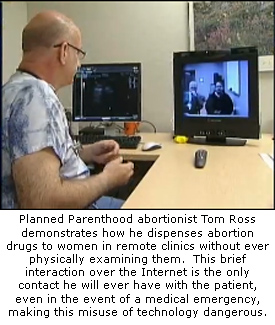
The Iowa Board of Medicine ruled a couple of weeks ago to end webcam abortions – often referred to as "telemed" abortions – in which the abortion patient, in a remote location, converses via webcam with an abortionist elsewhere. Once the brief screening is done, the abortionist punches a button and a drawer opens in front of the woman, dispensing abortion chemicals she then takes at home.
 
Jenifer Bowen of Iowa Right to Life tells OneNewsNow the Iowa Board of Medicine made a sound decision.
 
"They felt that [because of] the lack of oversight, the lack of providing a doctor, the lack of follow-up care that Planned Parenthood of the Heartland provided, that women were and have been at grave risk here in the state," she states.
 
The RU-486 regimen has already proven to be dangerous on a national level. Thousands of complications are on record, according to Bowen.
 
"We know of at least 15 deaths from medication abortions throughout the United States," she explains, "as well as over 2,200 adverse effects of women who have nearly hemorrhaged to death or [suffered] ectopic pregnancies and those sorts of things."
 
Planned Parenthood is asking the judge to overturn the Board's decision and resume telemed abortions. Iowa was the first state to implement such abortions.
 
Contact: Charlie Butts, OneNewsNow.com

Federal Judge overturns one provision of Texas’s pro-life HB 2 but Pain-Capable Unborn Child provision not challenged and went into effect Tuesday

U.S. District Judge Lee Yeakel
 
Austin-based U.S. District Judge Lee Yeakel overturned a portion of Texas's pro-life HB 2 that required abortionists to have admitting privileges in a hospital within 30 miles. Texas Attorney General Greg Abbott is expected to file an emergency appeal of Yeakel's order to the 5th Circuit Court of Appeals in New Orleans.
 
However Judge Yeakel offered a mixed conclusion on that portion of HB 2 that addresses chemical abortifacients and how they are administered.
 
Although addressed in media accounts as little more than a side note (at best), the ACLU, the Center for Reproductive Rights, Planned Parenthood of Greater Texas, and several other Texas clinic owners did not challenge that part of HB2 which prohibits killing unborn children who have reached the developmental milestone of being able to feel pain which substantial medical evidence places at 20 weeks, if not earlier. Pro-abortionists are leery about taking on a law that clearly demonstrates that the pain-capable unborn child is a living member of the human family worthy of protection.
 
The Pain-Capable Unborn Child Protection Act is now the law in ten states.
 
Judge Yeakel and the 5th Circuit Court of Appeals have disagreed about abortion-related laws previously. He issued a temporary injunction against a Texas law that disqualified abortion business affiliates from participating in the state's Women's Health Program which first a three-judge panel and then the full circuit overturned.
 
In his decision today Judge Yeakel declared that "the act's admitting-privileges provision is without a rational basis and places a substantial obstacle in the path of a woman seeking an abortion of a nonviable fetus." At last week's three-day trial, some abortion clinics argued that they had been unable to find hospitals willing to admit their abortionists and as a result a sizable proportion would be forced to close down.
 
Texas Solicitor General Jonathan F. Mitchell disputed those assertions, "saying the group had no evidence to support its claims and was wrongly trying to shift the burden of proof to the government." Mitchell maintained that the admitting-privilege rule would not pose an "undue burden" on women seeking abortions, which would remain available in Texas.
 
Moreover, "The Supreme Court has recognized that the state's interest in promoting fetal life is present throughout pregnancy," Mitchell said.
 
The measure requires that the abortionist be in the same room as the woman receiving the chemical abortifacients (which is not the case with so-called 'web-cam" abortions) and that abortionists follow the protocol approved by the FDA for the use of the two-drug "RU-486" abortion technique. The two drugs are the RU-486 itself which kills the baby and a prostaglandin which induces contractions to expel the now dead baby.
 
What Judge Yeakel appears to be saying is three-fold. First, that it is not an undue burden for Texas to require that abortionists use the FDA protocol that limits the technique to the first 49 days EXCEPT for those "women for whom surgical abortion is, in the sound medical opinion of their treating physician, a significant health risk during the period of pregnancy falling 50-63 days."
 
Second, abortionists cannot tinker with the FDA protocol with one exception: the respective dosages of RU-486 and the prostaglandin can be altered. Abortionists like to use more of the cheaper prostaglandin than the more expensive RU-486.
 
Third, it is acceptable to require the abortionist "must examine the pregnant woman," which is not done in web-cam abortions where the abortionist communicates via teleconferencing.
 
Contact: Dave Andrusko, National Right to Life

National abortion rallies ignore pain of women, critics say

 
A national campaign to depict abortion as a normal and positive experience has drawn criticism for overlooking the harm that abortion causes to women and their unborn children.
 
"This campaign reinforces the political beliefs about the goodness of abortion without giving women a chance to be honest about how they feel about their abortion or their lost child," said Tina Whittington, executive vice president for Students for Life of America.
 
The problem with "encouraging women to fit into this mold that says 'I am okay with my abortion and I feel no regrets,'" she told CNA on Oct. 30, is that "it takes away their rights to feel regret, loss or sadness."
 
"This is part of the reason why it takes women so long to seek help" for counseling after an abortion, Whittington continued. Rather than dealing with the pain they experience, women feel pressured to "stand behind a message point."
 
Ultimately, she said, the campaign tells women, "We don't care about your complicated emotional or psychological health, all we care about is getting this political agenda moved forward."
 
Whittington responded to a nationwide effort to re-energize the abortion movement in the U.S., led by Advocates for Youth and supported by other groups including NARAL Pro-Choice America, Planned Parenthood Federation of America and the Religious Coalition for Reproductive Choice.
 
The campaign has involved the coordination of more than 130 events in some 30 states and 100 college campus in order to promote abortion access and oppose regulations on abortion.
 
At the center of the campaign is an effort to "destigmatize abortion and promote access" by promoting stories showing abortion as a normal and positive experience for women. The initiative centers on the findings from a 2011 survey from the Guttmacher Institute stating that 1 in 3 women in the United States would have an abortion by the age of 45.
 
However, pro-life advocates noted that the campaign fails to take into account the stories of women who have had traumatic or negative experiences from their abortions, nor does it mention the children who were adopted after their mothers chose life in difficult and challenging situations.
 
"Many of these 1 in 3 are deeply wounded and struggle daily with the decision they made or were coerced into," said Marjorie Dannenfelser, president of Susan B. Anthony List.
 
Overlooking these stories is overlooking the well-being of these women, she said.
 
"This is just another example of how pro-abortion forces put the institution of abortion above the wellbeing of individual women."
 
Dannenfelser told CNA that "post-abortive women who speak out about their experiences have been instrumental in encouraging other mothers to choose life and winning hearts and minds to the pro-life cause."
 
One of the rallies, held Oct. 28 in Washington, D.C., featured comments from Advocates for Youth president Deb Hauser, who explained that "every good story that mobilizes needs a villain."
 
According to rally organizers, one of the purposes of the event was to fight those who would "shame" women who have had abortions. A poem read at the rally criticized individuals who pray near abortion clinics, saying that they express "judgment" and oppose "freedom."
 
Dannenfelser explained that the campaign is pushing for abortion to "be normalized in our society."
 
But ultimately, she stressed, "the pro-life argument that there are two unique people – a mother and a child – at the center of every abortion decision will always win out."
 
Contact: Adelaide Mena, CNA/EWTN News

Dillard questioned about vote on pro-abortion Human Rights Commissioner

 
GOP gubernatorial candidate State Senator Kirk Dillard says there was confusion about the qualifications for Human Rights Commission appointees, and that while he voted in committee to approve an pro-abortion activist for the spot, he opposed the nomination on the Senate floor.
 
"Senator Dillard voted 'no' on the floor to Terry Cosgrove ... the actual or 'real' recorded vote," Dillard campaign spokesman Wes Bleed told Illinois Review. "There was some confusion over qualifications in committee. Sen. Dillard definitely opposes Mr. Cosgrove's appointment to the Human Rights Committee."
 
During the October 15th Executive Appointments hearing, Senator Dillard was the only Republican that joined the Democrats in approving abortion activist Terry Cosgrove for re-assignment to the Human Rights Commission. Cosgrove, who actively raises campaign funds for abortion supporters through Personal PAC, will be paid $46,960 annually for serving on the commission from March 2013 until November 2017.
 
Two other Republican senators - Tim Bivins and Matthew Murphy voted "no" in committee, and State Senator Sam McCann was not in the room during the vote. All eight Democrats voted "yes."
 
 
When AM157 came before the Senate floor last week, the vote was divided along party lines - 36 to 20:
 
 
Source: Illinois Review

Pro-Life National 'Judicial Petition' Initiated

 
A national Petition effort aimed at the Judicial Branch of the U.S. Government was initiated this month by a Spokane, Washington Pro-life group. This is the first known petitioning of the Federal Judiciary in two hundred years. It seeks to have any Federal Court define the word "person," which has never been done legally -- either for the born or the unborn.
 
This "JUDICIAL PETITION," a legal action that is a right under the First Amendment, is a single sheet, two-pages long and takes about ten minutes to read. It may be read and signed electronically by anyone, including students, 14 years of age and older. The Petition is available at the Spokane group's website: http://www.spokaneprolife.com
 
Petitions will be delivered to individual Federal District Courts once 10,000 petitions have been signed per Federal Court. There are 90 Federal District Courts in the United States. The goal is for one-million signed Petitions by January 22, 2015, the anniversary of Roe v. Wade, 1973.
 
This effort comes about as a result of four years of effort on the part of the Spokane group, including a legal case which made its way from Spokane, Washington to the U.S. Supreme Court in March of this year. The Spokane group's intent is to make this Petition as public as is humanly possible, to rationally convince the Courts that they have a legal duty under their Oath of Office as Federal Judges to "say what the law is," therefore, to define "person," which appears 50 times in our greatest law, the Constitution. Marbury v. Madison, 5 U.S. Cranch 137, 176-180, (1803).
 
The Spokane Pro-life group may be contacted at their website: http://www.spokaneprolife.com or by e-mail: JUDICIALPETITION@gmail.com.
 
Contact: Lawrence Cronin, Spokane Pro-life

Author of "The Exorcist" says abortion is "demonic"

 
Forty years after his book "The Exorcist" rocked America, author William Peter Blatty is upset by HHS Secretary Kathleen Sebelius and her obsession with promoting abortion. To him, abortion is "demonic." He's someone who would know.
 
In an interview with the Washington Post, Blatty explains his concern about his college alma mater Georgetown University, and its embrace of Sebelius last year. He's so concerned that he signed onto an effort expressing disgust with the Catholic-rooted school, and urges them to reverse their current speaker policies, saying:
 
"If you truly love someone that you think needs to be in rehab, you'll do everything you possibly can to get them into rehab," Blatty says. The last straw, he says, was Georgetown's invitation of Kathleen Sebelius, secretary of the Department of Health and Human Services,to be a commencement speaker in May of last year. Sebelius has a record of supporting abortion rights, and abortion is the issue that really sets Blatty's nerves on fire.
 
He describes, his voice trembling, a particular abortion procedure in graphic detail.
 
He pauses. His voice is nearly a whisper.
 
"That's demonic."
 
Source: Illinois Review

October 24, 2013

ObamaCare: Advancing the Abortion Industry

Pro-abortion President Barack Obama
 
On a Friday night back in December 2009, Senate Majority Leader Reid was in tense negotiations with then-Senator Ben Nelson of Nebraska, as Reid desperately needed Nelson's vote to secure Senate passage of ObamaCare. Finally, Nelson had what Politico described as a "breakthrough" that lead to a deal, as Politico reported a few days later. Part of the deal, Politico wrote, was that "people who receive federal subsidies would need to write two separate checks as a way to ensure that none of the federal dollars went toward the abortion premium."
 
Six days later, Senator Nelson took to the Senate floor to explain in detail the deal he had negotiated. With respect to the two check requirement, Senator Nelson said: "In the Senate bill, if you are receiving Federal assistance to buy insurance, and if that plan has any abortion coverage, the insurance company must bill you separately, and you must pay separately from your own personal funds–perhaps a credit card transaction, your separate personal check, or automatic withdrawal from your bank account– for that abortion coverage. Now, let me say that again. You have to write two checks: one for the basic policy and one for the additional coverage for abortion. The latter has to be entirely from personal funds." [155 Cong. Rec. S14134 (Dec. 24, 2009)].
 
At the time, the Washington Post quoted Cecile Richards, president of the Planned Parenthood Federation of America as saying, "The absurdity of requiring these two separate checks doesn't accomplish anything toward the supposed goal of segregating federal funds. . . . It just creates additional hoops for insurance companies . . . and more administrative burdens and obstacles for women to get the coverage they need." Likewise, a NARAL factsheet bemoaned the Nelson language: "Requiring individuals to write two checks in order to purchase coverage that includes a benefit–abortion services . . . is a new, unnecessary hassle. . . . these burdens could severely limit women's ability to obtain abortion coverage within the exchange." (Note, an Exchange is a marketplace for the purchase of health insurance. ObamaCare requires an Exchange to be established in every state by 2014).
 
The ObamaCare statute specifically requires the issuers of Exchange plans that cover abortion to "collect from each enrollee in the plan" a "separate payment" for the type of abortions for which funding is prohibited under the Hyde Amendment (which is all abortions other than in cases of life of the mother, rape, or incest) and a separate payment for all other services. [42 U.S.C. 18023(b)]. These separate payments are then to be deposited into separate accounts.
 
During the regulatory process, commenters questioned HHS on how this was to be implemented, and according to HHS, the commenters "recommended that HHS clarify . . . whether [Exchange plan] issuers may satisfy the separate payment provision by providing each enrollee with an itemized bill, and whether an enrollee's coverage would be terminated for failure to comply with the separate payment provision." Rather than doing so, HHS merely said that the comments would be taken into consideration in any future guidance. [77 Fed. Reg. 18430 (March 27, 2012)].
 
Now, despite the clear language of the ObamaCare statute, it appears that the separate check requirement is not going to be enforced by the Obama Administration. Gretchen Borchelt, director of state reproductive health policy at the National Women's Law Center, told the Huffington Post that "we used to talk about it as being two checks that the consumer would have to write because of the segregation requirements, but that's not the way it's being implemented." (Huffington Post, Sept. 3, 2013).
 
Likewise, a spokeswoman for Rhode Island's Exchange told PolitiFact Rhode Island that "the customer is not billed a separate fee." (Politifact, Oct. 2, 2013. The Rhode Island Exchange will handle the billing, not the plan issuers). As PolitiFact notes, "it turns out to be a hidden fee."
 
From a pro-life perspective, the most important fact is that massive federal premium subsidies will go to Exchange plans that cover elective abortion (a sharp departure from the longstanding policy of the Hyde Amendment), and every enrollee in the plan will have a portion of the enrollee's premium placed into a separate account for elective abortions (dubbed the "abortion surcharge"). But this is just one example of how the Obama administration is implementing ObamaCare in a way so as to advance the abortion industry.
 
Essential Community Providers. ObamaCare regulations require health insurance issuers in an Exchange to ensure "reasonable and timely access" to a "broad range" of Essential Community Providers for low-income individuals in the plan's service area. Among these Essential Community Providers are clinics that receive Title X family planning funds, such as Planned Parenthood clinics. (Planned Parenthood is the largest provider of abortions in America today). A search of the non-exhaustive list of Essential Community Providers maintained on an HHS' website reveals 589 Planned Parenthood clinics among the Essential Community Providers.
 
Not to leave a stone unturned, in October 2011, Planned Parenthood and other abortion advocacy groups, wrote HHS asserting that "we believe that the final rulemaking should include language that clarifies that health plans, Exchanges, and states cannot exclude or discriminate against providers because they provide or refer for comprehensive women's health services." Apparently, these groups were concerned that a state might choose to direct women to health care providers that don't perform abortions. Of course, the Obama Administration addressed their concern. When the Final Rule was issued, it included a new provision that explicitly states that a health plan issuer in an Exchange "may not be prohibited from contracting with any essential community provider." (45 CFR 155.1050).
 
Abortion Coverage for Congress. A provision within ObamaCare requires that Members of Congress and certain congressional staff purchase their health plans on the Exchanges, starting January 1, 2014. The Obama Administration writes the regulations implementing this statutory language and in doing so, they propose allowing the government to purchase abortion-covering plans for Members of Congress and their staffs, which is something that no other federal employee is allowed to do.
 
For most of the past 30 years the "Smith Amendment" has banned the Office of Personnel Management (OPM) from paying any administrative expenses for any plan that includes elective abortion coverage. OPM does not dispute the application of the Smith Amendment to the purchase of Exchange plans by Members of Congress and certain congressional staff. Rather, OPM erroneously asserts that the Smith Amendment prohibits OPM from using appropriated funds to "administer" Exchange plans by administering "the terms of the health benefits plans offered on an Exchange." This deceptive assertion ignores the plain wording of the Smith Amendment which explicitly prohibits the use of any appropriated federal funds "to pay for . . . the administrative expenses in connection with any health plan . . . which provides any benefits or coverage for abortions." (emphasis added). It is undeniable that OPM will incur "administrative expenses in connection with" the purchase of Exchange health plans that cover abortion. The Constitution does not grant the President the authority to retroactively rewrite the laws.
 
Application Assisters. Planned Parenthood affiliates are being enlisted in various capacities to help consumers select an Exchange health care plan and complete their applications. On August 15, the U.S. Department of Health and Human Services (HHS) announced that Planned Parenthood affiliates in Iowa, Montana, and New Hampshire will be funded as ObamaCare "Navigators." Their combined funding will total over $655,000. On August 13, the Washington, D.C. health insurance Exchange awarded a $375,000 grant to Planned Parenthood of Metropolitan Washington, D.C. to be an In-Person Assister. It is sadly ironic that some consumers may end up going to affiliates of America's largest abortion provider for help in purchasing insurance to cover life-preserving treatments.
 
This is just the beginning. The Obama Administration has three more years to implement ObamaCare.
 
Contact: Susan T. Muskett, J.D., Senior Legislative Counsel, National Right to Life

European Parliament: Abortion is Not a Human Right

 
The European Parliament this week rejected a measure that would force EU nations to declare abortion a human right.
 
Wendy Wright, with the Catholic Family and Human Rights Institute (C-FAM), said it would have been a "back door way" of forcing abortion on other countries.
 
"And it not only would have told countries in Europe that they must have abortion, but even would have told them that they must implement sex education — giving a reference to a certain curricula that was promoted by the World Health Organization," said Wright, C-Fam's vice president for government relations.
 
WHO is a pro-abortion organization that guides the UN on "global health matters."
 
Some members of the Parliament voted to send the pro-abortion report back to committee, while others wanted it removed entirely.
 
"It was expected just to sail through because only five minutes was allowed for debate — and it was only because pro-life and pro-family activists in Europe really geared up," Wright explained. "And to the surprise, I think, of the woman who introduced this measure, it did not pass."
 
There are plenty of activists in the U.S. pushing for late-term abortion.
 
"It's a teaching moment so that we can point out to people that there are, in fact, some in high positions who believe that a certain class of human beings should be killed indiscriminately — that mothers should not be protected from the abortion industry that wants no limits, no restrictions on what they do to women."
 
Contact: Bethany Monk, CitizenLink

Pro-choice woman describes RU-486 abortion ordeal

 
RU-486, the abortion pill, is offered to women who are less than nine weeks pregnant. When it first became available in the United States, pro-choice activists rejoiced. They believed that it would make abortion more readily available to women.
 
Abortion providers say that RU-486 is safe and effective. According to abortion provider Dr. David Grimes:
 
"I just don't see any downsides. For those women who don't like the invasiveness of surgery, it gives them a very important option."
 
In an article in Marie Claire titled "Betrayed by a Pill," a pro-choice woman named Norine Dworkin-McDaniel gives another perspective when she describes her RU-486 abortion.
 
She starts out by talking about how happy she was when RU-486 became an option for women.
 
"From the moment it was approved in 2000, I believed in the abortion pill. Finally! Abortion would finally become what it always should have been: a private medical matter between a woman and her doctor. It held the promise of swift, at home termination. There would be no more gauntlets of protesters at clinics, because who would know which physicians were dispensing the pills? Even better, the pill would keep abortion accessible at a time when fewer gynecologists were willing to perform them out of fear of attacks."
 
Dworkin – McDaniel eventually was faced an unplanned pregnancy. According to her, when she became pregnant, she was using cocaine and would "work all day, and party, party, party all night."
 
She worried that her drug use would cause medical problems for the baby:
 
"No matter what I did from this point on, there would always be a chance that the baby would have problems – maybe physical ones, maybe psychological issues. I wasn't willing to roll the dice with another life."
 
So Dworkin – McDaniel decided to end that life instead.
 
She describes how she decided not to have a surgical abortion:
 
"There was the surgical option of course. I'd had one in college (so you think I would've learned this lesson already) and I dreaded the needle that would be used to numb my cervix."
 
The abortion would be done by RU-486, (mifepristone) which would kill the baby. Then a second drug (misoprostol) would cause her to expel the embryo and placenta.
 
She says:
 
"The Mifeprex literature described some cramping and bleeding, "similar to or greater than a normal, heavy period." This sounded far more appealing than surgical abortion. A few pills, a couple of cramps, and it would all be over. We could move on with our lives."
 
But it didn't work out as she had planned.
 
She took the mispristone and then, two days later, prepared to administer the misoprostol:
 
Clinic staffers had directed me to insert the tablets into my vagina in the morning so I'd have the day to recover. I envisioned recuperating on the couch with some uncomfortable but bearable cramps and soothing myself with bad daytime TV."
I never made it to the couch."
 
She describes in detail what happened:
 
"Nothing – not the drug literature, the clinic doctor, not even my own gyno – had prepared me for the searing, gripping, squeezing pain that ripped through my belly 30 minutes later. I couldn't even form words when Stewart [her boyfriend] called to check on me. It was all I could do to gasp, "Come home! Now!" For 90 minutes, I was disoriented, nauseated, and, between crushing waves of contractions, that I imagine were close to what labor feels like, racing from the bed to the bathroom with diarrhea."
 
Then, just as quickly, it was over. The next night, I started bleeding. I bled for 14 days. A follow-up ultrasound confirmed that I'd aborted. And that's when the problems really began.
 
I had been prepared for the possibility that the pill wouldn't work and I'd still need a surgical abortion – that happens in about 5 to 8 percent of cases. I also knew that I might bleed so heavily I'd need surgery to stop it… [But] what blindsided me, apart from being battered by the mifepristone, with a huge, cystic boils that soon covered my neck, shoulders, and back. I was also overcome by fatigue – an utter lack of ability to do anything more strenuous than sleep or lie on the couch. My brain felt so fuzzy – English seemed like a 2nd language, and I couldn't work. On top of all that came depression; I sobbed constantly. I wouldn't leave the house. I stopped showering.
 
It was only when I described my symptoms to my gynecologist that I discovered my experience wasn't all that unusual. (The Mifeprex literature didn't even mention it) "I think it's underreported, but probably one in 3 women have dramatic side effects," he told me. My body was in total chaos – pregnancy hormones clashing with anti-pregnancy hormones clashing with stress hormones. "I've seen a lot of women go through it – I don't want to call it postpartum, but post event melancholy that's more dramatic than people want to admit." He prescribed antidepressants. "One day, you'll feel just like your old self." It took 9 months."
 
Dworkin – McDaniel describes going back to the clinic and talking to one of the clinic workers:
 
"We could have told you it wasn't going to be easy," a clinic staffer noted when I rattled off my complaints during my follow-up.
 
Why didn't she speak up sooner?"
 
Dworkin – McDaniel's story is similar to that of Abby Johnson. Johnson was the director of a Planned Parenthood clinic when she had an RU-486 abortion. She too was unprepared for the ordeal. You can read her story here.
 
Johnson describes the agonizing pain and heavy bleeding she experienced. At one point she says:
 
"I knew I had to get up and wash the blood off of me. I stood up slowly and straightened out my body. As soon as I was completely upright, I felt a pain worse than any other I had experienced. I began to sweat again and felt faint. I grabbed on to the side of the shower wall to steady myself. Then I felt a release…and a splash in the water that was draining beneath me. A blood clot the size of a lemon had fallen into my bath water. Was that my baby? I knew this huge clot was not going to go down the drain, so I reached down to pick it up. I was able to grasp the large clot with both hands and move it to the toilet. I stood in the warm shower for a few minutes…feeling a little relief from the cramping. Then came the excruciating pain again. I jumped out of the shower and sat on the toilet. Another lemon sized blood clot. Then another. And another. I thought I was dying. This couldn't be normal. Planned Parenthood didn't ever tell me this could happen. This must be atypical. I decided that I would call them in the morning…if I didn't die before then. It was around midnight and I had been in the bathroom for a good 12 hours. I knew I couldn't leave yet. I didn't want to lay in the bed…the bleeding was too heavy. And the clots were still coming; not as often, but they were still coming. So, I decided to sleep on the bathroom floor that night…right by the toilet. The cold floor felt good on my face. I was physically depleted, but I could not sleep."
 
In the morning, she called the clinic:
 
"The next morning, I called Planned Parenthood as soon as they opened and asked to speak to the nurse. I was told she would call me back soon. She did. I told her about my previous day. She told me, "That is not abnormal." WHAT?? She could not be serious. All of the bleeding, the clotting, the pain…that was NORMAL??? "Yes," she said. "Use heating pads, soak in a warm tub, and take Ibuprofen." I was angry. How could they not tell me the side effects? I felt betrayed."
 
She goes on to say:
 
"At a management meeting, I voiced my concerns. Why weren't we talking about the risks? Why hadn't anyone told me? "Well, we don't want to scare them," my supervisor said. "Oh, like they are scared when they think they are dying from the amount of blood they are losing because we choose not to tell them that is supposedly normal," I responded. That didn't go over too well. That was their answer? They didn't want women to be scared?? The night of my medication abortion, lying on the cold bathroom floor, I had never been so scared."
 
It's true that not every woman who uses RU-486 has such a terrible experience. But these bad experiences are more common than many abortion providers would have us believe. Abortion clinics present RU-486 as an easy option. Often, it is anything but.
 
Contact: Sarah Terzo, LiveAction News, and Norine Dworkin-McDaniel "BETRAYED BY A PILL" Marie Claire (US), Jul2007, Vol. 14 7, p184-186


LA doctors perform heart surgery on unborn baby after practicing with Jello and grapes

Dr. Ramen Chmait, assistant professor
at Keck School of Medicine of USC and
director of Los Angeles Fetal Therapy
 
Earlier this month, the L.A. Times reported on a rare cardiac surgery which was performed on a 25-week-old fetus in utero. The procedure — a first in southern California — was necessitated by poor blood flow through the baby's left ventricle. Because the baby's heart was not pumping blood properly, it was likely that he or she would have been born with hypoplastic left heart syndrome, which is a life-threatening condition.
 
This video shows a clip of the ultrasound used during the surgery, during which doctors inserted a tiny tube and inflated a balloon into the baby's heart to open up the poorly-functioning valve. To prepare for the highly specialized surgery, doctors practiced on a grape (representing the baby's heart, which is about the size of a walnut at 25 weeks gestation) inside of Jello, which represented the baby's body surrounding the heart.
 
Although the surgery was performed just late last month (making long-term effects hard to predict at this time), doctors reported that the baby and mother are doing well and that it was evident immediately after the surgery that blood flow had increased and that the surgery was likely to have prevented life-threatening problem's for the future. One of the physicians told the LA Times:
 
"It's only been a week or two, but even initially after the procedure, we could see increased blood flow across the valve, and the heart was squeezing a bit better than before."
 
In a scholarly article posted by the American Heart Association (AHA), the fetal aortic valvuloplasty procedure (which was performed on the baby in this story) is listed as the most common type of closed fetal cardiac intervention. Interestingly, the AHA points out that the performance fetal cardiac intervention in utero is helpful to the baby because it occurs during a period of intrauterine gestation that is especially helpful to the baby's recovery process:
 
"Prenatal intervention may also allow the fetus to recover in the supportive in utero environment, during a developmental period when there is enhanced wound healing and the capacity for myocyte proliferation."
 
Editor's note. Lauren Enriquez has worked for great organizations such as Texas Right to Life and Students for Life of America. This appeared at liveactionnews.org
 
Contact: Lauren Enriquez, National Right to Life

Hobby Lobby joins Obama Administration in asking Supreme Court to Take Its Appeal

Hobby Lobby's David and Barbara Green
 
Last month the Obama Administration asked the United States Supreme Court to take up the case of Hobby Lobby, a chain of more than 500 arts and crafts stores. Today Hobby Lobby asked the court to review the case as well.
 
Back in July, U.S. District Judge Joe Heaton granted a preliminary injunction against the HHS mandate which force employers to purchase health insurance for their employees that includes coverage for items and procedures to which they have moral or religious objections.
 
Subsequently the full 10th U.S. Circuit Court of Appeals also ruled in favor of Hobby Lobby, which employs more than 13,000 full-time workers.
 
However, since then courts in other parts of the country have ruled differently. Such conflicting circuit court decisions often are resolved by the High Court.
 
The Administration's position is that corporations, like Hobby Lobby (but many other challenger as well), cannot claim a religious exemption to this part of the healthcare law. (As David Savage of the Los Angeles Times has explained, the cases "involving corporate employers are separate from suits involving schools and hospitals that have religious affiliations.")
 
On Monday Hobby Lobby asked the U.S. Supreme Court to review its case and decide whether the Green family will be required to provide and pay for the coverage it finds morally and religiously objectionable.
 
"Hobby Lobby's case raises important questions about who can enjoy religious freedom," said Kyle Duncan, general counsel of the Becket Fund for Religious Liberty and lead lawyer for Hobby Lobby. "Right now, some courts recognize the rights of business owners like the Green family, and others do not. Religious freedom is too important to be left to chance. The Supreme Court should take this case and protect religious freedom for the Green family and Hobby Lobby."
 
The Court will consider the government's petition and Hobby Lobby's response next month, Duncan explained. If the petition is granted, the case would be argued and decided before the end of the Court's term in June.
 
There are two primary reasons the High Court is likely take the case. "The justices rarely turns down requests from the White House," according to POLITICO's Jennifer Haberkorn. "Plus, three circuits [the third, sixth, and tenth] have now decided this issue in different ways, creating a circuit split."
 
Editor's note. The above includes information sent out in a release by the Becket Fund for Religious Liberty.
 
Source: National Right to Life News

Yale Hosts Inaugural Pro-Life Conference

 
It's not something you see every day: A student-led pro-life conference at one of the nation's Ivy League universities. But with the success of the inaugural event, members of Choose Life at Yale (CLAY) are hoping to see others like it.
 
"Vita et Veritas: Promoting a Culture of Life and Truth" ran from Thursday through Sunday. Some of the speakers included Sally Winn, vice president of Feminists for Life and Clarke Forsythe and Bill Saunders of Americans United for Life.
 
"In an institution that is so pro-choice, it's important to have that alternative view," said CLAY member Courtney McEachon, the organization's out-going president. She described Yale as "hostile" to the pro-life view.
 
Event speakers, she said, helped attendees see how varying philosophical or religious views could eventually all lead to the pro-life stance.
 
Former abortionist Dr. Haywood Robinson gave a talk Saturday called "The Secret Agenda."
 
"The title drew a lot of people — they wanted to hear what he had to say," McEachon told CitizenLink. Robinson focused on abortion sellers and their economic goals.
 
"Both sides sometimes assume that Planned Parenthood and other pro-choice groups are looking out for the best interests of women, but they do have alternative motives," McEachon explained. "Abortion is a huge moneymaker."
 
In just 2009, Planned Parenthood's estimated revenue from abortions was $191 million, according to Carrie Gordon Earll, senior director of Public Policy for Focus on the Family.
 
Although CLAY was formed in 2003, this is its first conference.
 
"There are students here who want to support life," she said.
 
Tim Goeglein, vice president for external relations at Focus on the Family, said Yale's conference underscores a dedication to the pro-life movement.
 
"The Yale gathering is a pro-life tribute to the growing numbers of young Americans who agree with the late Father Richard John Neuhaus, that babies should be welcomed into the world and protected in law," he explained. "This Ivy League gathering is a sign of vitality and renewal."
 
Contact: Bethany Monk, CitizenLink