March 23, 2012

AUL files brief to protect IL pharmacists' conscience rights


Americans United for Life filed an amicus brief in an Illinois appellate court today, in the case of Morr-Fitz, Inc. v. Pat Quinn, defending the fundamental First Amendment right of conscience. At issue in the case is an Administrative Rule, originally issued in 2005 by then-Governor Rod Blagojevich, which requires pharmacists - regardless of religious or conscience beliefs - to dispense life-ending 'emergency contraception.'

AUL's brief demonstrates that the Rule unconstitutionally forces pharmacists and pharmacies to violate their religious beliefs. This case is brought in the midst of the current controversy over the Obama Administration's healthcare law that refuses to protect the conscience rights of Americans who do not want to pay for abortions or drugs that induce abortions.

Dr. Charmaine Yoest, CEO and President of Americans United for Life, stated, "This Rule forces Illinois citizens to violate their consciences and religious convictions as they attempt to earn a living and support their families. It forces pro-life pharmacists and pharmacies to advance an abortion-driven agenda in violation of their First Amendment conscience freedoms."

In the brief, AUL is representing national medical organizations including the American Association of Pro Life Obstetricians and Gynecologists, Christian Medical & Dental Associations, Catholic Medical Association, Physicians for Life, and National Association of Prolife Nurses.

Source: Americans United for Life

Public Has 90 Days to Comment on Mandate for Abortion-Causing Drugs


The Obama administration on Friday released an advance notice of the public rule requiring all employers to provide insurance that covers drugs that could cause early abortions, inviting public comment for the next 90 days.
 
But according to experts who've analyzed the fine print, the administration only seems to be asking for help in balancing its priority — free contraceptives, sterilizations and abortifacient drugs for all women — with the religious freedoms of employers.
 
The 32-page notice asks the public for input on which, if any, organizations should be exempt from the mandate. "What entities should be eligible for the new accommodation (that is, what is a 'religious organization')?" it asks.
 
Moreover, should religious employers be allowed to object to providing some forms of "contraception," but not others?
 
"This is an administration that pushed through ObamaCare despite the fact that there was overwhelming disapproval of the bill, said Sabrina Schaeffer, executive director of the Independent Women's Forum. "This appears in some ways to be some backpedaling. It's unclear whether it's their way of appeasing people or demonstrating they're listening, when they have no intention of making any changes — which is my perception of the way this administration actually works."
 
Friday's notice refers several times to free "contraceptives" — some of which cost as little as $9 a month — but that's not all employers or insurance companies will be forced to provide for "free" once the mandate takes effect. Sterilization surgeries also would be provided — and according to Planned Parenthood, those can run anywhere from $1,500 to $6,000 apiece.
 
"Benefits like this cost a tremendous amount," Schaeffer said. "They will cost women and their families. And then there are all the moral objections people have. It's frustrating because (the administration keeps) coming back to this 'many women use birth control' argument. But the contraception mandate is as much about birth control as the American Revolution was about tea. This is about the basic separation of church and state, and that's sadly being overlooked in all this."
 
What the notice really indicates, said Grace-Marie Turner, president of the Galen Institute, is that by suggesting alternative ways to pay for the mandate, the administration is quietly admitting its idea has failed.
 
"But the religious organizations would still be required to make sure all of their employees have access to the offending coverage," she wrote in National Review Online on Saturday. "So nothing has changed."

Contact: Karla Dial
Source: CitizenLink


Pro-Life Caucus Discusses Abortion in ObamaCare


The Congressional Pro-Life Caucus, joined by members of several family advocacy organizations, on Wednesday held a press conference exposing the mechanisms by which the federal health insurance exchanges set up in the new federal health care law force all taxpayers to subsidize  abortions.
 
While Congress was out of session last week, the Obama administration issued a final rule saying that all insurance companies wishing to take part in the exchanges will include surcharges of "no less than $1 a month" in every plan consumers buy. They also aren't allowed to tell consumers about it up front.
 
That, said the congressmen, violates the Hyde Amendment — a longstanding federal law stating that no taxpayer dollars can be used to pay for abortions, or insurance plans that cover them.
 
"There is nothing benign or compassionate about brutally taking the life of an unborn child through dismemberment or chemical poisoning," said Rep. Chris Smith, R-N.J., the caucus co-chairman. "The president would like the American public to believe that his health care overhaul does not subsidize and facilitate the preventable tragedy of abortion, but his actions paint quite another picture."

Contact: Karla Dial
Source: CitizenLink

2011 not Planned Parenthood's best year

   
Though Planned Parenthood's annual report for 2011 shows an increase in the number of abortions it performed, pro-lifers see the decrease in abortion facilities as a victory.

Jim Sedlak of the American Life League (ALL) tells OneNewsNow that Planned Parenthood closed more facilities than it opened in 2011, marking the sixth straight year of facility decline.

 "They opened 11 new facilities, and they closed 47 of their existing facilities," he reports. "So at the end of 2011, Planned Parenthood now has 749 clinics across the country."

That is the lowest count since 1984, according to Sedlak, and is due in part to states eliminating or reducing funding for the clinics. Facilities that were not making a profit were also closed. But the Obama administration insists on continuing to grant $350 million in taxpayer contributions annually to the abortion-provider.

 "Barack Obama is so in love with Planned Parenthood that he will sacrifice anything for that organization," Sedlak offers. "He is so beholden to them for helping get him elected that earlier this year, he threatened to shut down the entire government rather than take one penny away from Planned Parenthood." That has become a campaign issue, notes the pro-lifer.

 While the number of clinics dropped, the number of medical and surgical abortions performed by the agency increased 41 percent. However, ALL's senior research analyst, Robert Gasper, concludes in his report that 2011 was a "remarkable year in the fight against Planned Parenthood," with the U.S. House of Representatives voting to deny federal funding to the abortion giant, and nine states passing legislation to defund the organization.

Contact: Charlie Butts
Source: OneNewsNow

Students' tuition funding contraception


College students are calling for passage of a federal law to block the contraception mandate on their insurance exchanges under the new healthcare law.

Kristan Hawkins of Students for Life tells OneNewsNow students' premiums will be paying for contraception, sterilization surgery, and the "morning-after" pill, even if it violates their religious beliefs.

 "It's the same mandate that we've been talking about since February nationally, but now it's being applied directly to university and college healthcare plans," she says. "So … we've been talking a lot to students about this and how this relates to them and why it's so important. Well, this just hammers it home because now they're going to be funding this in their tuition."

Hawkins accounts that once students are made aware of what the government is forcing them to do, they are enraged. But the passage of a measure currently before Congress would help them fight this mandate.

 "There's a bill in Congress, [the] Respect for Rights of Conscience Act, sponsored by Congressman Jeff Fortenberry (R-Nebraska)," she reports. "We've got to get this bill passed in Congress and make President Obama account for this mandate."

 Students for Life is making an action kit available for pro-life students to help energize their peers to take action against the ObamaCare requirement.

 This coverage will also be available to college-age women who are not in school.

Contact: Charlie Butts
Source: OneNewsNow

Teen-abortion bill would give parents a say


Members of Congress again are seeking to restrict interstate transportation for minors' abortions after years of failures to enact the legislation.

The Child Interstate Abortion Notification Act (CIANA), H.R. 2299 in this Congress, was first introduced in 1998 but has never reached the president's desk for signature. A House of Representatives subcommittee heard testimony from supporters and opponents of the measure in a March 8 hearing.
 
Under the bill, a person knowingly transporting a minor who lives in a state requiring parental involvement for an abortion would need parental permission or a bypass granted by a judge in order for the procedure to occur in another state. The bill would also require abortion providers to notify parents before performing an abortion on an out-of-state minor. Violators would face not more than one year in prison or a fine.

In the 28 states that have passed parental involvement laws, "the research shows that there is a statistically significant reduction in the in-state minor abortion rate from anywhere from 13 percent to 42 percent," said Michael New, assistant professor of political science at the University of Michigan-Dearborn.

Passing a parental notification law has helped the overall health of girls, according to New's research. It has reduced pregnancy in 15 to 19 year olds and lowered incidents of gonorrhea and suicide in the same age bracket, he said.

Testifying on behalf of the Episcopal Church, Katherine Ragsdale, president of Episcopal Divinity School in Cambridge, Mass., told the subcommittee her church has adopted a resolution against parental permission laws in hopes of helping young women in difficult situations.

"Our position encourages the very things this bill would outlaw," Ragsdale said at the hearing. "Certainly, we want young people to be able to turn to their parents. But when they can't or won't, we want to make it easier, not harder, for them to turn to other responsible adults and, most certainly, we don't want to make it harder for their doctors to be their allies and advocates."

Rep. Jerrold Nadler of New York, the lead Democrat on the House constitution subcommittee and a bill foe, pointed to an example of a child who could not speak to her parent about her situation. The 13-year-old from Iowa was "shot to death by her father after he found out that she terminated her pregnancy, Nadler said. The pregnancy was the result of incest, Nadler said, with the father causing the pregnancy.

But bill supporter Teresa Collett, professor of law at the University of St. Thomas in Minneapolis, said parental permission laws have bypasses.

"In those few cases where it is not in the girl's best interest to disclose her pregnancy to her parents, state laws generally provide the pregnant minor the option of seeking a court determination ... of the girl's best interests," Collett said.

Of the 28 states that enforce parental involvement laws, 22 require only one parent to grant permission for the abortion.

Abortion is a serious procedure and holds consequences for a person's health, such as "increased risk of breast cancer; extremely premature birth in subsequent pregnancies, at 28 weeks of gestation or less, and suicide," said Rep. Trent Franks, R.–Ariz., the subcommittee's chairman.

Since 1998, the bill -- in various forms -- has received approval from the House but has gained passage in the Senate only once. The House and Senate approved different versions of the legislation in 2006, but Democrats blocked a negotiated bill from receiving a vote on final passage.

At the hearing, Nadler predicted a similar fate for this session's measure, saying, "This bill we have considered in the 106th, 107th, 108th, 109th Congresses, and I presume that we will have no more success in this Congress."

Contact: Mark Norton
Source: Baptist Press

$1 abortion surcharge decried by pro-lifers

    
     Rep. Chris Smith, R-N.J., criticizes at
     a March 21 news conference the latest
     Obama administration rule endorsing
     abortion funding health care. Photo
     provided by Rep. Smith's office


In a Wednesday (March 21) news conference on Capitol Hill, members of Congress and leaders of pro-life organizations decried the latest rule regarding the 2010 health care law, dubbed by critics as Obamacare. Since the rule's March 12 release, pro-lifers have pointed to two particularly objectionable aspects in a document that is more than 640 pages in length:

-- Health insurance plans in state exchanges are prohibited from specifically publicizing the fact they provide abortion coverage. They can disclose such coverage "only as part of the summary of benefits and coverage explanation, at the time of enrollment."

-- Every person enrolled in an insurance plan that covers abortion must pay a separate, monthly fee of at least $1 as an "abortion surcharge."

"So there will be millions, and perhaps tens of millions, of pro-life Americans who won't have a clue that abortion coverage is in their package until the day they sign on the bottom line," Rep. Chris Smith, R.-N.J., said at the March 21 news conference.

The "surcharge" and secrecy clause in the new rule are only the latest to be confirmed in a series of provisions protested by pro-life advocates and objectors to government funding of abortion.

Pro-lifers have decried the fact the law will permit federally subsidized abortions. Religious liberty advocates have joined pro-lifers in also objecting to a January rule -- like the latest one, also from the Department of Health and Human Services -- that requires all health plans to cover contraceptives and sterilizations as preventive services without cost to employees. The contraceptives, as designated by the federal government, include some drugs that can cause abortions of tiny embryos. That rule has a religious exemption critics find woefully insufficient.

The "surcharge" and secrecy clause are "really a sideshow," said Douglas Johnson, legislative director of the National Right to Life Committee (NRLC), at the news conference.

"It is a diversion from what's going on in the main tent, which is the federal subsidies," he told reporters. "We're talking about a massive new program, so-called tax credits. This is money coming straight out of the federal treasury which is going to subsidize the purchase of these plans for tens of millions of Americans."

The cost to the federal government could be $80 billion a year, Johnson said.

Smith said, "Now, under Obamacare, taxpayer subsidies in the form of what's called refundable, advanceable credits paid directly to the insurance company -- that is to say, taxpayer funds -- will subsidize insurance plans offered on the exchange that include abortion on demand -- even late-term abortion."

There are no restrictions on the reasons for abortions or how late they may be performed under the regulation, according to NRLC.

Charmaine Yoest, president of Americans United for Life, told reporters, "[A]s we predicted at the time that Obamacare was passed, the state exchanges do cover abortion and will force many Americans to pay for abortion regardless of their own personal, deeply held beliefs. That's not American. That's not the country that we live in. Many Americans will be compelled by law into an insurance plan that covers abortion."

Fifteen states have enacted laws barring abortion coverage in health plans that are part of the exchanges, but those "opt-out" measures fall short of fully protecting pro-life citizens, according to NRLC.

"A state legislature may forbid coverage of abortion in the exchange-participating health plans in that state -- but under ObamaCare, the taxpayers who live in that state may not 'opt out' of subsidizing the abortion coverage for other Americans, perhaps numbering tens of millions, who live in other states that do not enact opt-out laws," NRLC reported in a March 16 analysis.

In addition, the health-care law also empowers the Office of Personnel Management to offer "multi-state" health plans that could permit federal health plans that cover abortion, according to NRLC.

In the last 15 months, the House of Representatives has passed three bills that would repeal the health-care law or bar funding for abortion under the law. In each case, Obama has threatened a veto, and the Senate has either defeated or refused to vote on the proposals.

It appears repeal of the health-care law or reversal of its abortion-funding provisions will require the election of a Senate and a president supportive of such changes -- or action by the U.S. Supreme Court. The court will hear oral arguments March 26-28 on the constitutionality of the health-care law.

Contact: Tom Strode
Source: Baptist Press

RALLY in defense of religious freedom


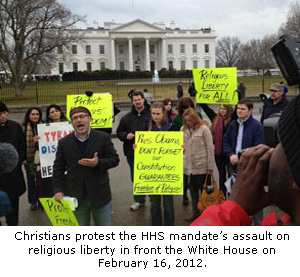
All 181 Bishops have signed the letter opposing the recent HHS (Health and Human Services) mandate regarding religious freedom. This mandate attacks the core of our Constitutional rights!
This is a reminder of the rallies planned across the country to defend our religious freedom!

Please make every effort to join, Friday March 23, at Noon in a RALLY in defense of religious freedom and STAND UP against the Obama administration's HHS Mandate at federal buildings in cities across the country. I have listed only those in Illinois; however St. Louis and other cities close to Illinois will be holding them as well. Please goto: http://standupforreligiousfreedom.com/ and check for the city nearest you!
 
If at all possible, please attend the rally closest to you. If time or location prevents you from joining us personally, Please join us in prayer between Noon and 1:00pm. Faithful Citizenship is everyone's responsibility!

~~~~~~~~~~~~~~~~~~~~~~~~~~~~~~~~~~~~~~~~~~~~~~~~~~~~~~~~~~~~~~~~~~~~~~~~~~~~~~
Illinois
Chicago:
Federal Plaza
50 W. Adams Street (Map)
FacebookRSVP the Chicago rally on Facebook
E-mail the Rally Captain

Freeport:
Lincoln-Douglas Debate Square
114 E. Douglas Street (Parking Locations)
E-mail the Rally Leader

Peoria:
Peoria Courthouse
324 Main Street (Map)
E-mail the Rally Leader

Rockford:
Holy Family Parish
4401 Highcrest Road (Map)
Mass preceding Rally at 11 a.m.
E-mail the Rally Captain

Sterling:
Grandon Civic Center
310 E. Park Avenue (Map)
Mass at 11 a.m. Prior to Rally

March 21, 2012

Voters out to beat Obama hand Romney big IL edge


Voters hunting for a candidate who can defeat President Barack Obama and with the proper experience helped vault Mitt Romney to victory Tuesday in Illinois' presidential primary, according to results of an exit poll of voters.

 Illinois-Latest results
      10,421 of 10,448 precincts - 99 percent
     
      x-Mitt Romney, 430,535 - 47 percent
      Rick Santorum, 322,831 - 35 percent
      Ron Paul, 85,872 - 9 percent
      Newt Gingrich, 73,362 - 8 percent


Illinois delegate count:

     10,421 of 10,448 precincts - 99 percent
      51 of 54 Delegates allocated
     
      Mitt Romney 41 - 75 percent
      Rick Santorum 10 - 18 percent
      Newt Gingrich 0 - 0 percent
      Ron Paul 0 - 0 percent

Romney's win was also powered by robust margins from people worried about the economy and federal deficits.

Main challenger Rick Santorum ran strongly among people who want their contender to be a true conservative and to exhibit strong moral character, and with the most religiously driven voters. But Illinois only has modest proportions of such voters, narrowing the former Pennsylvania senator's appeal.
 
"Romney is a little too liberal for the Republican base. But that's the only way you can win. You've got to get the independents," said Norm Jay, 78, of Wheaton, Ill., who backed the former Massachusetts governor.

Underscoring how the Illinois contest occurred on terrain that was not the friendliest for Santorum, 34 percent on Tuesday called him too conservative. That was the highest proportion of voters expressing that view in any of the half-dozen states so far where that question was asked.

Romney won 74 percent of those seeking a candidate who can defeat Obama. Among 17 states where voters have been polled so far, that proportion has only been surpassed in Romney's home state of Massachusetts and in Virginia, where he and Texas Rep. Ron Paul were the only competitors.

Romney also got 64 percent of people seeking the right experience. Combined with those seeking a candidate who can best handle Obama, that gave Romney a forbidding lead among over half of those who showed up to cast ballots, the survey showed.

Romney, who has used his business background to cast himself as the candidate best equipped to create jobs and eliminate federal waste, bested Santorum by more than 20 percentage points among voters riveted on the economy and the federal deficit as top issues. People with those concerns accounted for over 8 in 10 voters, making Romney's strong edge with this group impossible for Santorum to overcome.

Voters from families earning at least $100,000 a year and college graduates also tilted strongly toward Romney. That proved decisive, since those earning less than that amount and those without degrees split about evenly between him and Santorum.

Santorum, outspoken on the campaign trail about the importance of faith, had a 20 percentage point margin over Romney among voters saying that sharing religious beliefs with a candidate mattered greatly. Such voters, though, accounted for shy of 1 in 4 voters, a slightly smaller share than average among states whose voters have been surveyed so far.

Around two-thirds of the votes of those seeking a real conservative and a contender with strong character were backing Santorum. But such voters comprised less than half the overall vote.

"I don't know if he (Romney) is willing to deal with the hard issues or if he would back down from them," said Don Gramer, a Santorum voter who works for the Catholic diocese in Rockford, Ill.

Though Santorum won comfortably among those considering themselves very conservative, Romney did strongly with somewhat conservative voters and moderates.
 
Santorum, a devout Catholic, lost to Romney by 23 percentage points with Catholic voters, a problem he has encountered consistently this year. While the two men ran roughly evenly among Catholics who attend church weekly, Romney, who is a Mormon, had more than a 2-1 lead with Catholics who go to services less frequently than that.

Analysts have said that for Catholics, religious identity is a weaker factor in determining political views than it is for some other faiths.

Further showing how the makeup of Illinois voters worked against Santorum, he defeated Romney modestly among white born-again and evangelical voters, a group with whom he has generally prospered since the Super Tuesday primaries earlier this month.

But they only accounted for around 4 in 10 voters in Illinois, a bit lower than average in voting so far. Among the nearly 6 in 10 Illinois voters not in that group, Romney had a commanding 2-1 advantage.

Asked which candidate they would back if only Romney and Santorum were in the race, the difference in support between the two men narrowed a bit. That suggests that it might be somewhat to Santorum's advantage if former House Speaker Newt Gingrich and Texas Rep. Ron Paul dropped out of the race, which neither has suggested they are about to do.

Even as the third month of the GOP nominating battle nears a close with no end imminent, only around 3 in 10 Illinois voters said they want the race to end as fast as possible, even if their own candidate loses. Some Republicans have expressed worries that the length of the campaign has hurt the party's chances of defeating Obama because of the intense, repeated criticism the GOP contenders have fired at each other.

The survey of 1,621 Illinois voters was conducted for The Associated Press and the television networks by Edison Research. Interviews were conducted as voters left their polling places Tuesday at 35 randomly selected sites.

The survey has a margin of sampling error of plus or minus 4 percentage points.

Contact: Alan Fram and Jennifer Agiesta  
Source: Associated Press via OneNewsNow