
The tragic case of Sung Eun Grace Lee, the 28-year-old banker dying of brain cancer, made headlines when she won a lawsuit against her parents to have her respirator removed, and then changed her mind. But let's leave the Lees alone. They have enough problems without our looking over their shoulders.
But there's something going on in the reporting of the Lee case that I think does require our focus. The media ubiquitously reported the controversy as involving the "right to die." For example, this Los Angeles Times story headlined, "Grace Sung Eun Lee Fights for Right to Die, Chooses Life." But that is wrong. There is no such thing in the USA as a right to die. And may there never be.
There is a right to refuse medical treatment, the actual issue in the Lee case. That's not the same thing. Indeed, even when refusing treatment is expected to lead to death, people sometimes live Example, Karen Ann Quinlan, whose parents brought the first right to refuse treatment case back in the late 70s, successfully compelling doctors to remove a respirator. But Quinlan unexpectedly breathed on her own and lived for about 10 more years.
Similarly, the late humorist Art Buchwald expected to die from kidney failure soon after he exercised his right to refuse dialysis and entered hospice. But he didn't die. Indeed, he eventually left hospice and lived long enough to write his last book before finally succumbing.
The only type of withdrawal of care that will always result in death is removing food and water, as happened to Terri Schiavo. But even the removal of medically-supplied sustenance isn't a right to die, rather, to not be subjected to an unwanted invasive physical intrusion upon one's body.
But Wesley, what about assisted suicide? Sorry, that doesn't establish a right to die either. The legalization of assisted suicide and euthanasia actually creates a right for doctors to participate legally in terminating a qualified patient's life. If someone can't find a willing doctor, he or she has no right to force the physician to participate or refer to a doctor who will.
But surely, some of you might be saying, there is a right to commit suicide. Nope. There is often the power or ability to do so, but that's not the same thing as a right. Indeed, suicides can be forcibly prevented and the suicidal hospitalized involuntarily as long as they remain a lethal threat to themselves.
Bottom line: There is no right to die. It is an advocacy term used to push particular agendas, not an accurate description of the law.
Contact: Wesley J. Smith
Source: National Review

A just-released national survey shows that a clear majority of Democratic parents with school-aged children support abstinence education.
According to the study conducted by the National Abstinence Education Association (NAEA), eight out of ten Democratic parents and nine out of ten Republican parents support abstinence education. Valerie Huber, executive director of the NAEA, is not surprised by the findings.
"When we talk to parents and to students, we find pretty much unanimity and support for abstinence education," she accounts. "But we did think it would be a huge surprise to policy makers in Washington who are setting policy that's totally out of touch with their support base."
She finds it particularly interesting that 60 percent of Democrats and 70 percent of Republicans oppose President Obama's efforts to entirely eliminate abstinence education funding.
"That particular finding, I think more than any other question on the whole survey, shows that the White House is out of touch with what's not only in the best interest of young people, but what their constituency wants for their children," Huber concludes.
Contact: Bob Kellogg
Source: OneNewsNow.com

Moral theologian Father Thomas Berg is praising the work of Shinya Yamanaka, the winner of this year's Nobel Prize in medicine, for helping to "put human embryonic stem cell research largely out of business."
Yamanaka and John B. Gurdon, researchers in cell biology, were awarded the 2012 Nobel Prize in Physiology or Medicine for their discoveries about the generation of stem cells.
"Yamanaka will be remembered in history as the man who put human embryonic stem cell research largely out of business, motivated by reflection on the fact that his own daughters were once human embryos," Fr. Berg, professor of moral theology at St. Joseph's Seminary in Yonkers, N.Y. told CNA Oct. 8.
Gurdon's research was conducted in 1962 and showed that it is possible to reverse the specialization of cells. He removed a nucleus from a frog's intestinal cell and placed it into a frog's egg cell that had its nucleus taken out.
That egg cell was then able to develop into a typical tadpole, and his work was the basis for later research into cloning.
Until Gurdon's findings, it was believed that cell development could only happen in one direction, and that a mature cell nucleus could never become immature and pluripotent. A cell is called pluripotent if it can develop into any type of cell in the body.
Building on Gordon's work, Yamanaka published a paper in 2006 demonstrating that intact, mature cells can become immature stem cells. He inserted genes into mouse cells which reprogrammed those cells so that they became stem cells.
These reprogrammed cells are pluripotent. Yamanaka's breakthrough opened the door to studying disease and developing diagnosis and treatments.
Since this technique can produce a stem cell from any cell, it provides an alternative to embryonic stem cells, which are derived from destroyed human embryos.
"There is every potential for the morally licit use of the technique developed by Dr. Yamanaka--cell reprogramming. No part of the process need involve ethically tainted source cells," said Fr. Berg.
The Commission of the Bishops' Conferences of the European Community announced that this "is an important milestone in recognising the key role that non-embryonic stem cells play in the development of new medical therapies, as alternatives to human embryonic stem cells."
The announcement of the prize contrasts the success achieved in using non-embryonic stem cells with the disappointing results from embryonic stem cells. The commission's statement noted that "recently GeronCorp., the world's leading embryo research company, announced it was closing down its stem cell programme."
Fr. Berg said that "although tissues developed by this process (cell reprogramming) are not quite ready for robust human trials, much progress continues to be made."
It is hoped that this technique could someday lead to treatments in which a person's own cells are reprogrammed into organs that could replace any failing or damaged system.
Gurdon is a professor at Cambridge University, and Yamanaka is at Kyoto University. They will share the $1.2 million prize.
Contact: Carl Bunderson
Source: CNA/EWTN News

As the number of plaintiffs suing over the controversial HHS mandate reaches 100, a leading religious freedom legal group is hopeful about the outcome of the cases.
Kyle Duncan, general counsel for the Becket Fund for Religious Liberty, explained that "nothing the government has done in the past months changes the fact that the mandate still violates federal law and the Constitution by forcing religious organizations to pay fines for the privilege of practicing their faith."
Duncan told CNA on Oct. 9 that the Becket Fund is still confident as it moves forward with lawsuits against the controversial federal mandate that requires employers to offer health insurance coverage of contraception, sterilization and early abortion drugs, regardless of their religious beliefs.
In issuing the mandate, the Obama administration failed to offer a religious exemption to any group that serves or employs members of other faiths, as well as for-profit companies.
The administration did create a one-year "safe harbor" delaying the mandate from being implemented against objecting religious groups and has promised a future "accommodation" for religious freedom but has not yet given formal details about it.
The mandate has attracted legal action by more than 100 individuals and organizations, ranging from the first suit filed by Belmont Abbey College in Nov. 2011 – before many Americans were even aware of the mandate – to the most recent lawsuit filed by two Baptist universities on Oct. 9.
The plaintiffs include Catholics, Protestants, private individuals, religious organizations and for-profit businesses.
Among the diverse groups bringing lawsuits against the mandate are Eternal World Television Network, Hobby Lobby, the University of Notre Dame and several manufacturing companies.
Seven states have also sued over the mandate, along with numerous dioceses and Catholic Charities affiliates throughout the U.S.
Most of these cases are still waiting to receive a ruling. Bible publisher Tyndale House Publishers will appear at a hearing on Oct. 16, and Hobby Lobby has a hearing scheduled for the end of October.
One Colorado-based company, Hercules Industries, was successful in securing a temporary injunction against the mandate, while Missouri-based O'Brien Industrial Holdings lost its case in a federal district court but is appealing the decision.
In addition, a few cases have been dismissed as being premature, including those filed by Belmont Abbey College and Wheaton College. Courts determined that these plaintiffs were not facing imminent harm because the promised accommodation has not yet been finalized.
The colleges are appealing this decision, arguing that they are indeed suffering immediate injury under the mandate. They explained that their ability to hire new employees is significantly hindered if they cannot guarantee that they will be able to provide health insurance. In addition, they observed that the "safe harbor" does not protect them from private lawsuits by employees for failing to comply with the mandate.
A D.C. circuit court will hear an appeal that combines the cases of both colleges sometime after mid-November.
Emily Hardman, communications director for the Becket Fund, explained Oct. 9 that predicting a timeline for the rulings in the remaining cases is difficult because "each court can set their own times."
Even tougher would be guessing a timeline for a potential Supreme Court ruling, because that would require the cases to work themselves through the judicial system and be accepted for review by the nation's highest court.
However, Hardman observed that many insurance plans renew on Jan. 1, 2013, so the plaintiffs that are not protected by the "safe harbor" are likely to at least receive a ruling on whether they will be granted a temporary injunction by the end of the year.
She also pointed out that the results of the presidential election could offer a wave of relief to all of the plaintiffs at once. Republican candidate Mitt Romney has pledged to repeal the mandate, and his election in November would translate into a victory for everyone who is suing over the mandate.
But even if this happens, there is still need to be cautious, Hardman acknowledged. Some states have similar mandates that threaten religious freedom, although they are generally not as severe.
"The Becket Fund will continue fighting," she stressed.
Hardman said there is a need to engage the "public discussion" about the importance of religious freedom.
She noted that rhetoric about women's health and a "war on women" has become prominent in recent months, and this language could be leading people to believe that women have an inviolable right to free contraception at the expense of their employers.
It is important to counter these claims with facts, Hardman said. She explained that contraception is already widely available at low cost, so there is no crisis in access.
When people "look at what the mandate is actually doing," she said, they realize that returning to the system that was in place before the mandate took effect on Aug. 1 would not mean oppressing women, but leaving them free to purchase contraception as they see fit.
Educating the public about the nature of religious freedom is critical, agreed Duncan.
"Even if this mandate is scrapped, the bad principle behind the mandate must not be forgotten," he said, warning that it could "justify forcing religious people, organizations, and businesses to provide not only drugs their faith forbids, but also services such as abortion and assisted-suicide."
Contact: Michelle Bauman
Source: CNA/EWTN News

Nearly one in 10 registered voters in America say they will only support pro-life candidates who share their position on abortion, a number that is larger than the corresponding data for pro-choice voters, according to a new Gallup poll.
Specifically, 9 percent of registered voters say they will only support pro-life candidates who oppose abortion while 7 percent of all registered voters say they will only back pro-choice candidates who support legalized abortion.
All total, about one in six voters in America are single-issue voters on abortion.
Gallup's Lydia Saad called it a "slight pro-life tilt, albeit one that could potentially benefit pro-life Republican candidate Mitt Romney."
Where do the candidates stand on abortion? Read 'Election 2012: Obama & Romney on abortion' here.In fact, Gallup historical data shows the issue has benefited pro-life candidates in every presidential election dating back to 1996, with pro-lifers ahead by 2 percentage points in every election except for 2004, when 12 percent of voters said they'd support only pro-life candidates and 5 percent said they'd support only pro-choice ones. In 2008, the issue favored pro-lifers, 7 percent to 5 percent.
Two other questions on the survey also favored the pro-life community:
-- 27 percent of pro-lifers and 39 percent of pro-choicers say they don't see abortion as a major issue.
-- 49 percent of pro-lifers but only 43 percent of pro-choicers say a "candidate's position on abortion" is "one of many important factors" they consider.
Pro-choicers, Saad wrote, are more likely to vote for a candidate who disagrees with them.
"Making obvious overtures to abortion issue-voters could hurt Romney and Barack Obama with the broader electorate that may want to see the candidates focusing more single-mindedly on the economy," Gallup's Saad wrote. "It could also backfire by activating abortion voters on the other side to turn out for the opponent. However, it is likely that both candidates are using micro-targeting to find and appeal to these voters as part of a comprehensive campaign strategy to maximize support wherever it exists, particularly in swing states."
The Sept. 24-27 survey was based on interviews with 1,446 adults.
Contact: Michael Foust
Source: Baptist Press

The United Nations Human Rights Council (UNHRC) passed a resolution last week endorsing guidelines, crafted with input from abortion advocates, supporting abortion as a human right.
The resolution endorses a paper by UN High Commissioner For Human Rights Navi Pillay that refers to abortion as a "sexual and reproductive health right." The nations of New Zealand, Burkina Faso and Colombia are sponsoring the resolution.
Focus on the Family's Director of International Government Affairs Yuri Mantilla said the resolution is "a waste of time."
"The United Nations Human Rights Council should not be focused on trying to promote abortion as a human right," he said. There are so many violations of human rights around the world, and so many crimes against humanity, Mantilla explained, that "it would be more helpful to construct a narrative of international law that is consistent with justice."
Twenty of the 47 council members also oppose the resolution, which was adopted without a vote. The 20 council members submitted an opposition letter, which will accompany it when the UN General Assembly reviews the issue later this month. The resolution's text, according to the opponents, focuses on promoting new rights that are not defined in international human rights declarations, "mainly the reference to 'sexual and reproductive health rights.' "
The UNHRC should focus on "real human rights," he said, including the right to life, family rights and religious freedom.
FOR MORE INFORMATION
Read the U.N.'s "Universal Declaration of Human Rights."
Contact: Bethany Monk
Source: CitizenLink

Click here for the 2012 General Election IFRL-PAC Endorsements
Our mission is to help those who want their vote to protect the unborn, the disabled and the elderly. Those endangered innocent lives that are being threatened need men and women in government who respect all human life.
Our intent is to elect men and women of all political parties who will speak for and vote for legislation to protect the first and most important right for all of us - our right to life.
When more than one pro-life candidate seeks the same office, IFRL PAC always endorses the pro-life incumbent. There are a few candidates who we recommend over the opponent.
Some Candidates are Recommended this means that the candidate is pro-life but not endorsed.
Candidate Surveys for all candidates that returned surveys are on record at the IFRL office.
If you wish to inquire as to your candidate's positions on the pro-life issues, please call (217) 544-9700 and we will be glad to provide this to you. Click here for the 2012 General Election IFRL-PAC Endorsements

Theodore Shulman, a pro-choice activist who in 2010 threatened to kill several pro-life leaders, has been sentenced to 41 months in federal prison.
Shulman, 51, pleaded guilty in May to one count of transmitting a threat to injure another person. The targeted victims named in the case are Father Frank Pavone, National Director of Priests for Life, and Princeton University's Robert George.
In January 2010, as the trial of Scott Roeder, a man accused of killing abortionist George Tiller, was under way, Shulman posted a comment on the Catholic news site First Things, threatening that "if Roeder is acquitted, someone will respond by killing" Father Pavone and Mr. George.
Father Pavone stated, "I have already publicly forgiven Mr. Shulman and pray for him every day. I also renew, with my friend Bill Baird, known as the Father of the Pro-Choice movement, the joint statement we made years ago rejecting hatred and violence in word and deed between those on opposite sides of the abortion issue."
For more information, go to www.priestsforlife.org/nonviolence.
Contact: Leslie Palma
Source: Priests for Life
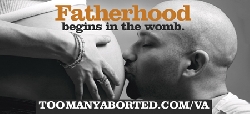 The Radiance Foundation, in partnership with the Virginia Coalition for Life, has launched a wide-scale TooManyAborted.com billboard campaign in Hampton Roads, Virginia, with the messaging: "Fatherhood Begins in the Womb." Twenty billboards and over one hundred bus and light rail posters have been placed throughout the region to raise awareness of the impact of fatherlessness on (born and unborn) children. The pro-family, pro-adoption initiative challenges the culture of abandonment and death that Roe v. Wade has fostered since 1973.
In the early 60s politicians raised the alarm about a 25% fatherlessness rate in the black community. Today, 41% of all U.S. children are born to unmarried women: 35.7% of white children and an astounding 72.3% of black children. Children who grow up in single female-led homes are 5 times more likely to live in poverty. Out of the 1.21 million annual U.S. abortions, 84% are among unmarried women. This is a nationwide crisis. Abortion and poverty have taken the place of fathers.
Infant mortality is nearly 2 times higher among father absent homes. Yet Planned Parenthood of Southeast Virginia (PPSEV) distorted black infant mortality rates to get approval from the Virginia Department of Health for an expansion to their Virginia Beach abortion center. The request was publicly rejected, then approved behind closed doors. PPSEV falsely claims their new medical addition will be used mostly for "urinary incontinence procedures." Ryan Bomberger, Chief Creative Officer of The Radiance Foundation, points out the absurdity: "Planned Parenthood isn't in the business of doing 'urinary incontinence procedures'. Abortion is what they do. Using 43 black infant deaths to justify causing more deaths is despicable." Bomberger, who is black, is an adoptee, adoptive father and Emmy® award-winning creative professional. "We need efforts that uplift the family, encourage responsibility and actually reduce the unintended pregnancy rate. Planned Parenthood has grossly failed at this core Title-X function by not budging the national unintended pregnancy rate since 1995, despite receiving half a billion taxpayer dollars annually."
Star Parker, syndicated columnist and President of C.U.R.E. (Center for Urban Renewal & Education), adds: "Planned Parenthood has injected its venom into urban America for decades. TooManyAborted.com exposes how they've left our inner-cities fatherless and made abortion the number one killer of black Americans." Contact: Ryan Bomberger,
Source: The Radiance Foundation,


